
Radical possibilities / the penguin lecture
My Accepted Society Symposium Keynote 2026

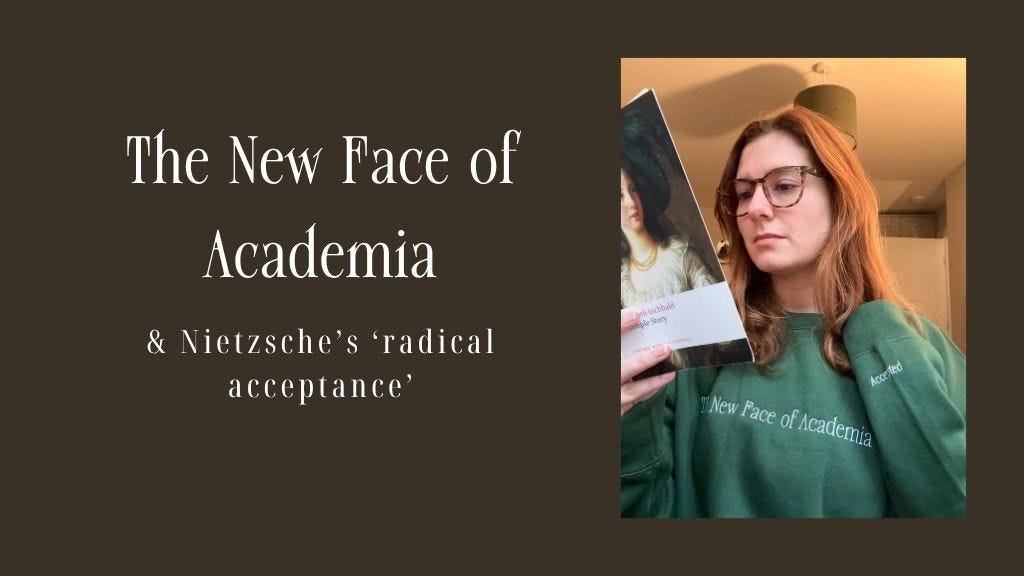
This concept, ‘the new face of academia, was my sole creative contribution to our Accepted merch relaunch in 2024, apart from all my 5am Club paraphernalia.
I don’t know where the idea came from or why it stayed with me so long that it needed to be immortalised as a sweatshirt. My one has travelled to Oxford and back, seen late nights, early mornings, stresses and joys, celebrating successes and absorbing tears that fell from over-exhausted eyes. The only other thing that has been with me during all those times, is the Accepted Society community. Even back then, in 2024, there was something about the way this community chose diverse pathways & new narratives of scholarship. Together, we are the new face of academia.
In many ways, this community is achieving what Frederick Nietzsche terms ‘self-overcoming’, essentially the idea of going beyond our nature, beyond our moral and social labels to achieve radical acceptance. You are here because there is a power that is driving us towards knowledge, and artistic self-mastery.
Much like, my little penguin friend here.
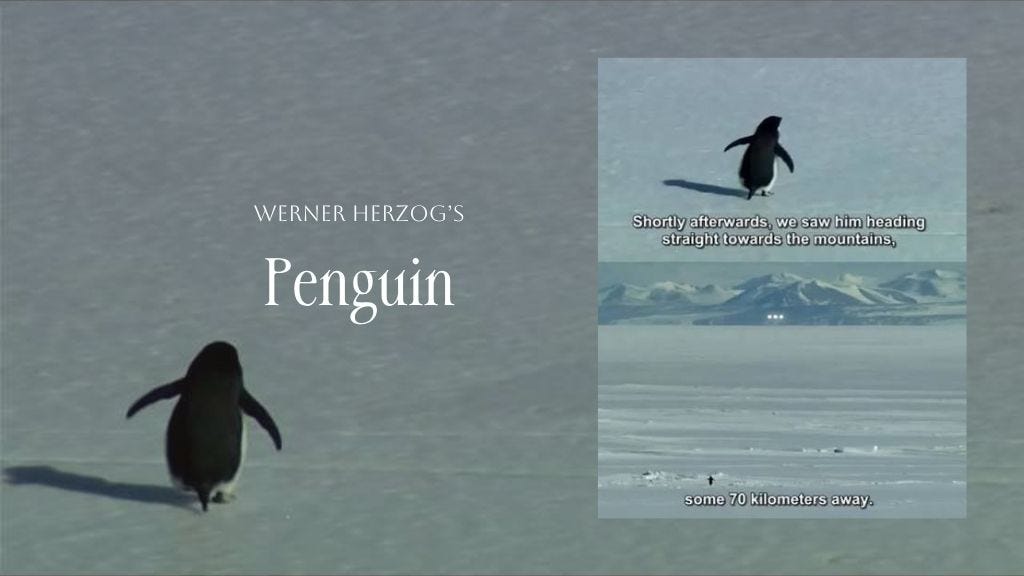
What is this little guy, or girl, doing? For some reason, the penguin breaks away from the colony and trudges into the treacherous, snowy inland of the Antarctic. Werner Herzog who captured this moment in 2007, prompted a dark philosophical look at instinct and isolation. This clip went viral, with many claiming that our penguin friend was a symbol of the active rejection of meaningless existence. He had turned away from the colony, the coastline, where there was food and protection, for something else.
How many of you relate to this penguin? How many of you have taken the courageous step to walk away from the colony to define your own intellectual journey? I would say that you all have, to varying degrees. All of you sitting here in Oxford, and all of you online, are all walking towards the mountain.
Now, Herzog claimed the mountain was certain death for our penguin friend, but I am a literature student, and moreover I study symbols in literature. Therefore, nothing is taken at face value for me. The mountain therefore means something more. For me it represents something different, a new era.
This year, in particular, I know I have felt like that little penguin. It has been a particularly long journey to the mountain but that journey really kicked off in July 2022, right here in this department.
But before I talk about that, I hope you will indulge me for a while with a trip down memory lane.
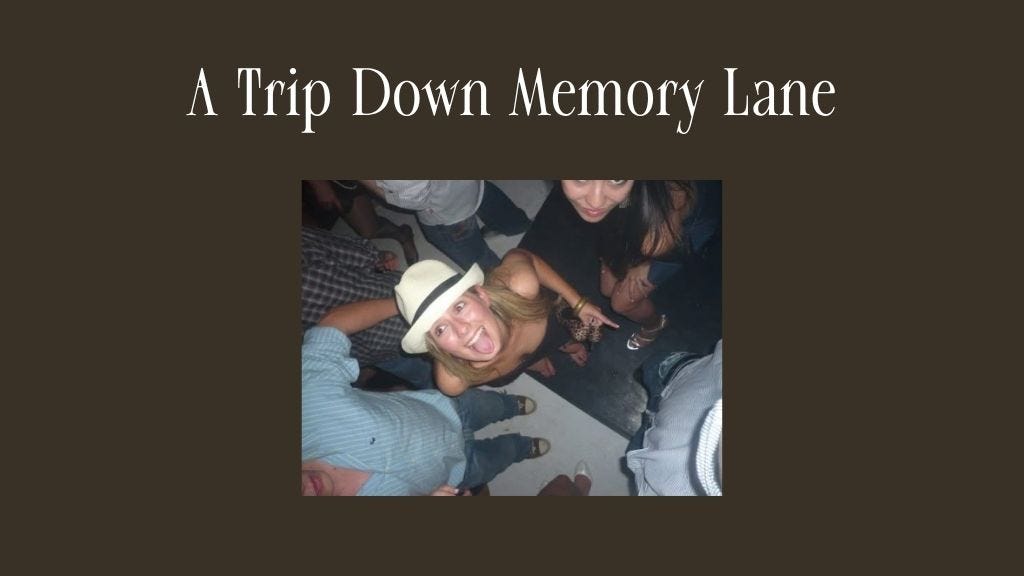
Yes, that is a delinquent 20 something-year old Cait. Note the leopard print heels that are being held, the bare-foot audacity in a club, the hat whose owner I do not know, nor do I know or recognise now any of the people surrounding me. I flash back to this moment because despite how fun it is to look back on this photo, I really pity this version of me. She did not know who she was.
There was a time before now that I did know who I was. I hope you will indulge me with some very raw emotions and memories here. I grew up in a violence-filled household. I don’t say this for pity. I say it because my childhood did not hold the foundational memories of their parents reading to them before bed, or telling them stories, or even just being told how the world works. At school, I didn’t do well. I was almost held back and I was taken to a therapist and put on medication at 6 years old and told to keep going. So that’s what I did.
But one day I was at a sleepover at a friend’s house. It was a truly idyllic setting. They had this country-style home with big comfy red sofas and a fireplace. And every night, my friend’s dad would come home from work, sit in the armchair, and read to my friend and her sister, and to me on that night. The book was a popular fantasy novel, and even though I came into the story halfway through, I found myself immediately transported. I was taken off to that far-away land, with magical creatures and characters that were overcoming evils every day. To say this book made an impression on me was an understatement.
The next chance I could, I took my pocket money to the nearest bookstore and purchased the book. For the first time in my life, at the age of 12, I read a book cover to cover. The very next book I purchased was J R R Tolkien’s The Lord of the Rings (yes, all three, folded into one big massive book)! Another big influence, and another journey to a mountain by a small person who no one thought much of. I had found myself in their stories which at first presented a means of escape, but now showed me a journey of hope. And it was with this hope that I read more and more, moving from fantasies to classics and popular fiction.
Jumping forward, my love of reading led me to the only career where I could make some money - law. I kept thinking back to this very pivotal moment in my life. It was my first year at university, well technically it was my first day. I sat in a registration hall, with the course hand book balance precariously on my one knee, Bible-like pages being flipped back and forth, while my clipboarded forms sat securely on my other knee. My pencil thrummed impatiently against the forms. Because I’m me, and I am that person, I arrived at the hall with my forms already half filled out with my upcoming first year law subjects. In neat little ring-fenced, designated boxes sat my law subjects. It wasn’t long, in my mind’s eye, before I would be living my best Elle Woods life, arguing for my client’s rights in court and walking out silhouetted in the bright shining sun.
In reality, I was sitting in this massive hall, rows and rows of chairs with students filling in forms. My half-filled forms were screaming at me to make a decision as I edged down rows towards the fierce-looking academic who would register these crucial decisions. I frantically paged through the handbook, looking at courses and subjects. I was immediately drawn to the English Literature courses. I read through the reading lists, the themes to be studied and I was immediately hooked! I could do this! My heart raced with excitement as I lowered my pencil to the blank boxes. I hesitated. My pencil resumed its tapping. Surely Literature could not help me with the life I wanted for myself. How was I to get a job with Literature? How would it support my law career? No, I thought, I should do something more practical, like Economics. Besides, I could read the syllabus in my own time, and study it myself on the side. It was here that I began to loose myself once again.
Jumping forward again, I found myself living my Elle Woods life, except it wasn’t a movie. Or if it was, it felt more like ‘The battle of Helms Deep’ (for all you Lord of the Rings fans) rather than ‘Legal Blonde’.
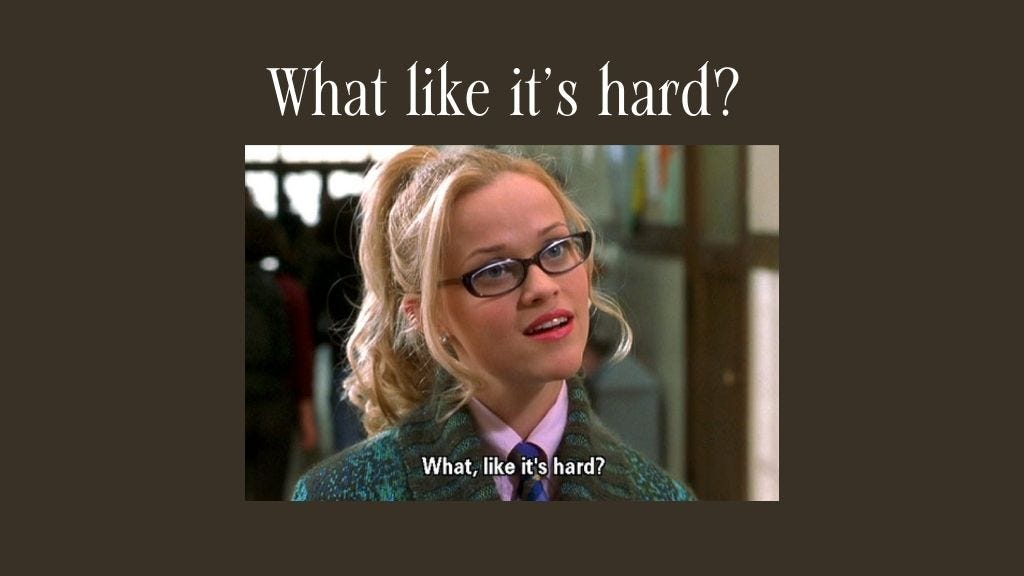
Yes Elle, it’s actually soul destroying, at least it was for me. I had gone straight into a corporate job when I graduated. The decision was an easy one. I needed the job and the regular pay cheque. I worked 12 hour days for terrible pay and a toxic environment. Competition was rife, with newly minted graduates scratching and crawling over each other for a glimpse of the ‘good life’ as an over-worked cog. Expectations of performance were high. High heels of a certain height were mandatory for women. Needless to say that my plan to read the syllabus for the university literature courses had flitted out of the window, along with that bright-eyed girl who used to spend all night reading.
I was a shell of myself. In a corporate world, you are taught that you are easily replaced. This is clear now more than ever with big tech companies valuing capital over people. Your individualism is stripped from you. You learn to thrive by developing a personae that operates for the ‘greater good of the company’. The corporate world is perfect for someone who can go to work, do what they need to, switch off, and go home (a work to live type of person). I am not that person. I am the person who will always put feeling into my work. I am a person who cares about people. I am the person who opts for the more meaningful and impactful work, rather than the money.
And so, during the COVID lockdown, while people learnt to bake bread, a task I tried and failed at miserably (I’ve accepted my fate). I took the time to take in English Literature classes. What followed is what many of you might have witnessed on my YouTube channel - I took a number of online certificates and courses, all of which I loved and none which actually gave me any credits. But what they gave me was HOPE. Hope that this could be a pathway I could take. And in July 2022, while I attended a summer school here at Oxford, through the department of education, I applied to do my Masters here too. It was the beginning of my journey to the mountain and now, I am working towards my PhD at Trinity.
I’m going to come back to the mountain in a bit but now I want us to travel to a very key moment in history. With the digital age, and constant political instability that we face, are we not beginning to lose faith in the established order? In the colony? Possibly we are now turning to the things that make us feel something; art, reading, writing, learning, something with spirit, rather than things that are technical, optimal, metric-based.
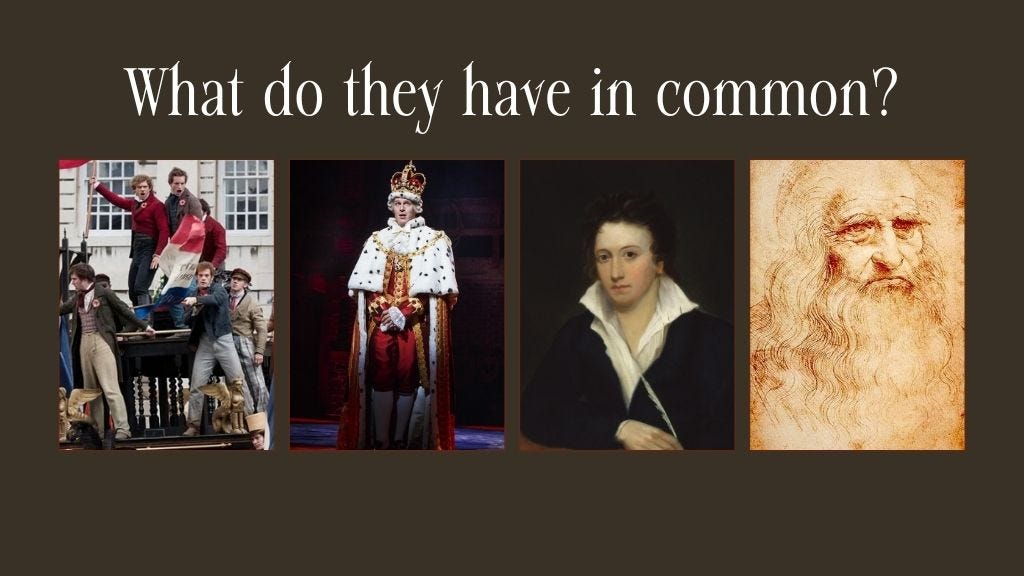
There have be really key moments in history where groups have pushed against society structures in order to reframe their own narratives
The French and American Revolutions saw the breakdown of political structures for the good of society and its people
The Romantics offered us an alternative to certainty. Romanticism is interested in the ineffable, the spiritual, and the importance of personal experience. It cannot offer us order and reason — only blind faith, and blind feeling.
The Renaissance placed humanity at the centre of importance.
Except today, we are enclosed by digital fences. The algorithms are the new enclosures. They promise us ‘connection’ while feeding us fragmentation. They promise ‘information’ while starving us of wisdom.
Today, we are facing another push against society’s structures; against consumerism and a commercialised digital age, against misinformation, political influence, hatred, and a breakdown of what it means to be human.
AI, metrics, algorithms, performative content, is all a means of creating that enclosure. We are herded into digital fences through algorithms, technology that we have become reliant on.
The Revolutionaries, the Romantics, the Renaissance thinkers had all watched society crumble before their very eyes. But in response to enclosed rule, the people stood up, revolted. And with the collapse of the old regime, artists began to search for new forms of meaning. Much like our little penguin friend.
Our little penguin friend could be argued as an actively rejecting mundane existence. However, it is also Romantic. Remember: that penguin isn’t only heading towards death; it is heading towards the mountains. And while those mountains are inhospitable, they are also full of beauty, and spiritual truth.
Those are things worth pursuing, even if you’re just a penguin.
So how do we follow him? How do we walk away from the colony? What is our Revolution, our Romanticism, our Renaissance?
For me, it is the choice to walk towards the mountain. It is our own choice to choose scholarship, to choose to learn, to choose to have faith and belief in the spirit of academia, not in the enclosed structures that originally defined it.
I want to encourage you all to take three radical steps:
Bring yourself into your work
Most art historians are similarly queasy about emotion and instead write about form, colour, influences, or historical context. Feeling, however, is not only unavoidable; it is crucial to understanding a work of art. Indeed, an artwork becomes senseless without it. In a letter to a friend, Henry James wrote, “In the arts feeling is always meaning”
- Siri Hustvedt in How to Live an Artful Life
Bring all your emotions, your personality, your experiences, your beliefs, into your work. Gone are the days of information being held behind the ivory tower, as Kaelyn’s keynote talks about.
Create real connections over stats.
As Siri Hustvedt suggests, art is the bridge between the subjective ‘I’ and the objective world. When you analyse a painting, or study a poem, you are not wasting time on abstract beauty. You are performing an act of intellectual resistance. You are saying: My perception is not for sale to the highest bidder.
Converse with the Past
Both Tolkien and Lewis, during their opposing times in Oxford, were united in a vision of the past as a vast mine of imagination and observation. In their view, to remain ignorant of this was to be so much the poorer.
This is so important in the space of ever changing and pressing trends, new algorithms. We must champion those contemporary writers who carry the flame of scholarly tradition and bring the important ideas of the age to our attention. At the same time, we mustn’t forget the gems and wisdom to be found in the past. Let us champion a comprehensive culture of reading, writing and sharing ideas.
The task is therefore to be both prophetic and academic and will be undertaken by those who have the courage to break out of those worldviews within which our subordination is held. As mini-historians, we need to show respect to our ancestors but ultimately our efforts should be directed towards creating the future in the light of our knowledge of the past. More often than not, great homage is paid to dead heroes than to living generations, our generation. Our responsibility, therefore, lies not with the dead but with the living. And if rationale be needed for such a stance, it can be found in the hope that the terminal disease of consumerism can be arrested before the living generations are obliterated.
Change as a community
Rebecca Kuang, author of Babel and Katabisis, talks about how when she was a teenager, she subscribed to the notion of a singular hero who could bring about change, and that is reflected in her writing. But as she’s gotten older she talks about how important it is to shift away from the self as being the change, and look to supporting, linking arms with followers to support those that are already doing the work. Change is community.
‘Resist doing what everyone else does simply because it’s what everyone else is doing: if you do what is true to you it will always be radical. Perhaps we need to remind ourselves of this every day’. - Katy Hessel
We are currently navigating a storm of misinformation and political instability that feels designed to make us feel small, cynical, and isolated.
But here is the radical truth: Academia is not a building. It is not a degree. It is not a title on a LinkedIn profile.
Academia is what we choose to pay attention to. It is the community we build that rewards curiosity over consensus. It is the life-long commitment to keep learning even when the world demands we stay static.
You are not waiting for permission to be an intellectual. You are not waiting for an institution to validate your pursuit of truth. You are the institution. Accepted Society isn’t a club; it’s an insurrection of the curious. We are the heroes of our own change. And yes, it requires the bravery of that penguin. It requires the willingness to be the one who turns away from the crowded colony to seek the truth for yourself.
If you take only one thing away today, let it be this: The mountain is not a place of death. It is a place of discovery.
When you go home tonight, I want you to remember that penguin. And I want you to realise something that Herzog didn’t show in his film: That when you start walking into those mountains, you are not alone. You look to your left, and you look to your right, and you see others from Accepted, arms linked, marching right beside you.
We are not just individuals walking into the cold. We are building the academia of the future—one that is community-led, life-long, and radically ours.
So, walk into the mountains. Curate your mind. Guard your attention. Be the hero of the change you wish to see.
Thank you.